Research
My work develops in two stages. The first is a completed bachelor’s thesis on cruise-company sustainability claims and water quality in Biscayne Bay, supported by a coding appendix and an exploratory consumer-perception survey. The second is a graduate research direction that moves from diagnosing an attribution gap to asking how cruise ports of call can compare access choices using place-based environmental evidence, operating conditions, governance and passenger experience.
The materials below are organized in this order: completed research first, supplementary documentation second, and a proposal for future study last. The graduate proposal is not a completed project or an engineering assessment.
Stage 1 — Completed undergraduate research
Cruise Tourism and Water Quality: Green Claims vs. Blue Reality in the Biscayne Bay Coastal System
Bachelor's thesis, University of Trento, 2026 · Graded 30/30 with honors. Supervisor: Prof. Angelo Besana. Co-supervisor: Prof. Antonio Bibbò.
The thesis examined 18 sustainability claims on water use, wastewater treatment, and food waste from Royal Caribbean Group, Norwegian Cruise Line Holdings, and Carnival Corporation. It considered whether fleet-level reporting could be assessed against independent environmental evidence from Biscayne Bay, where PortMiami is located. The study identified an attribution gap: the information available did not allow a measured local change in water quality to be attributed to a specific vessel or operator.
- Thesis and abstractdoi.org/10.5281/zenodo.23058847
- Coding appendixdoi.org/10.5281/zenodo.23062068
- Consumer perception survey reportdoi.org/10.5281/zenodo.23059433
- Cite asPapalotti, G. (2026). Cruise tourism and water quality: Green claims vs. blue reality in the Biscayne Bay coastal system [Bachelor's thesis, University of Trento]. Zenodo. https://doi.org/10.5281/zenodo.23058847
Stage 2 — Proposed graduate research
From Unverifiable Claims to Measurable Places: Cruise Access Choices at Ports of Call
A proposed master's-level framework for comparing cruise-port access choices through place-based environmental evidence, operating conditions, governance and passenger experience.
- Four-page summary (open access)doi.org/10.5281/zenodo.23083334
- Full 16-page proposalavailable on request
- Cite asPapalotti, G. (2026). From unverifiable claims to measurable places: Cruise access choices at ports of call [Research proposal]. Zenodo. https://doi.org/10.5281/zenodo.23083334
The thesis found a gap between broad sustainability reporting and the local evidence needed to assess a claim in a particular place. The proposed graduate research moves from that diagnosis to a practical question: what data, baseline conditions, responsibilities and monitoring arrangements should be in place before one access option can be considered preferable from environmental, operational and visitor-experience perspectives?
At a large homeport the gap is hard to close, because the infrastructure is already built. At ports of call it is still open, because the access arrangements are still being decided.
The Grand Cayman case
Grand Cayman is served only by tenders, and whether to change that has been contested for more than a decade.
In 2014 a floating pier system, SeaWalk, was publicly put forward as an alternative to fixed berthing. Its promoters described it as having "no environmental impact" — a location-specific claim of exactly the kind the thesis found unverifiable: no baseline, no indicator, no measurement window, no independent verifier. The system was already in use in Norway, where the first one was installed in 2012, and was later installed in Jamaica in 2019.
In 2015 the environmental impact assessment for the proposed George Town cruise piers estimated that roughly 15 acres of coral reef and associated habitat would be destroyed (Bailey et al., 2023). Cruise lines had also indicated that their newest ships would bypass tender-only ports (Bailey et al., 2023).
On 30 April 2025 a non-binding referendum asked whether the Cayman Islands should develop cruise berthing infrastructure. The official result recorded 11,973 votes against and 5,417 in favor, or 69% and 31% of the votes cast on the question. A further 1,275 people voted in the general election, or on the other referendum questions, without answering this one; including them, the shares are 64% and 29% (Elections Office, via IFES, 2025).
The case sets out the dilemma in a single place: a berth means dredging and habitat loss, tendering means waiting times, small-boat traffic and weather dependence, and the alternatives are presented to the public with environmental claims that cannot readily be checked.
The project treats this as an opportunity rather than a deadlock. Where access arrangements have not yet been built, they can be designed so that their effects are measurable from the start.
Comparative cases
Grand Cayman remains the lead case. Santorini adds the visitor-flow dimension, where tendering is followed by a landside cable-car ascent to Fira. Key West provides a contrasting governance case, where cruise access restrictions, community preferences and state-level intervention have shaped decisions over cruise access. Together, the three cases allow the study to compare environmental verifiability, passenger experience and governance across different destination settings.
Research questions
- RQ1. How do ports of call choose how to bring passengers ashore? When considering a berth, tenders, a floating pier or a conceptual offshore arrangement, how do they weigh environmental impacts, costs, economic benefits and practical constraints? What role do local communities' views play in that choice?
- RQ2. What information would a port of call require to evaluate the local effects of each access option? Which environmental and operational measures could be tracked at the level of a destination, an individual ship, a port of call, or a passenger?
- RQ3. How do cruise passengers think of the different options for getting ashore, and why? How much do factors such as travel and waiting time, safety, experience quality, information about local impacts, and any additional cost affect their overall decision?
Study design
The core of the study combines documentary analysis of the Grand Cayman case, a first round of semi-structured stakeholder interviews, and the development of an indicator matrix.
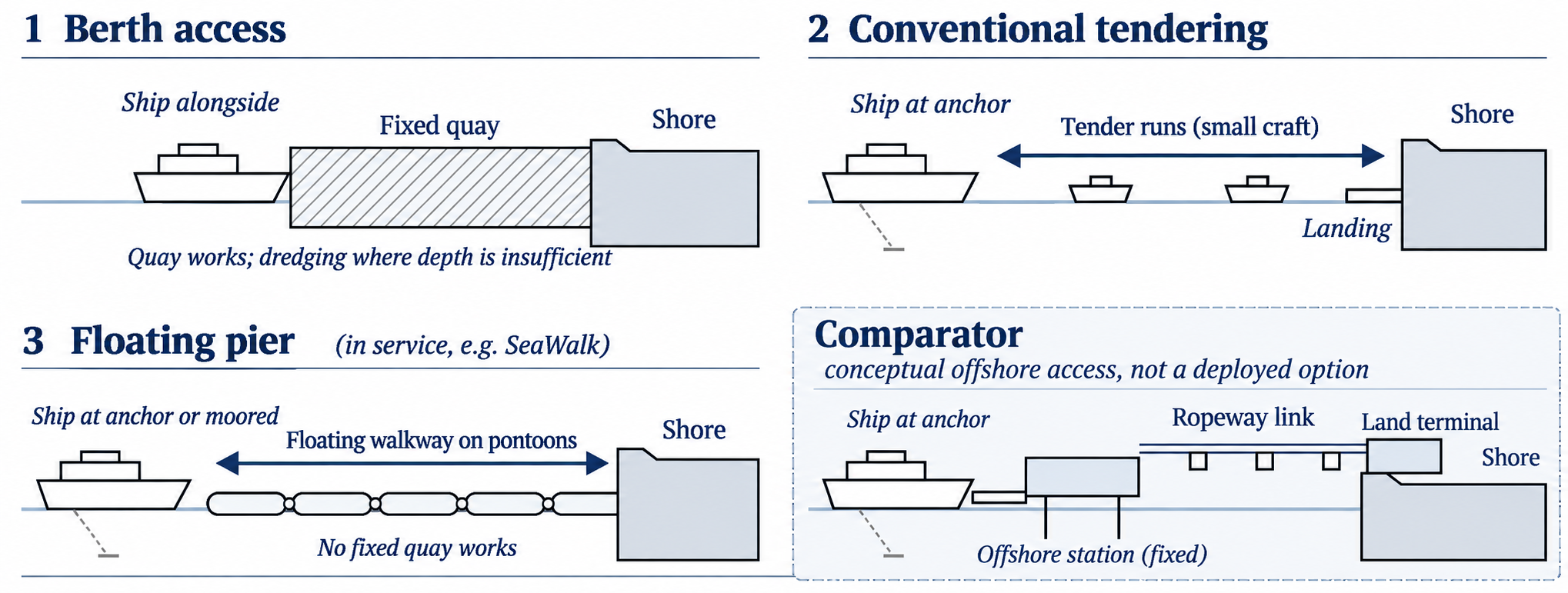
The indicator matrix is the main output. It produces no new environmental measurements. It specifies what should be measured, against which baseline, by whom, and at which scale. It is applied first to a system already in service, SeaWalk, and only then to a conceptual offshore configuration carried purely as an analytical comparator.
Comparative work in Santorini and Key West, together with the full passenger choice experiment, forms the extended component of the study. Its scope depends on supervisory guidance, ethical approval, access to sources and program resources. Data collection involving human participants begins only after IRB approval.
Access categories in the proposed study
Three of the four categories compared are arrangements in service today. The fourth is a conceptual offshore configuration, included so that the matrix can be tested against a case where no operating record exists at all — the hardest case for any claim of environmental performance. It is an analytical reference, not a proposed design, and the study does not conclude that any offshore option is preferable.
Research foundations and selected references
The proposal draws on four connected strands of scholarship: environmental communication and accountability; place-based cruise-destination impacts and governance; passenger experience and stated preferences; and mixed-methods research design. The list below gives the main foundations. The full reference list, including case documents and industry sources, is in the full proposal.
Environmental communication and accountability
These sources frame the difference between broad corporate environmental communication and information that can be independently checked in a defined place and time.
- Delmas, M. A., & Burbano, V. C. (2011). The drivers of greenwashing. California Management Review, 54(1), 64–87.
- Lyon, T. P., & Montgomery, A. W. (2015). The means and end of greenwash. Organization & Environment, 28(2), 223–249.
Cruise destinations, local impacts and governance
These sources support the focus on place-specific effects, baseline conditions, community trade-offs and the governance of cruise development. The 2026 CABI volume is the most recent synthesis of the field; its concluding research agenda notes that cruise sustainability remains under-theorized and lists governance gaps and tourist behavior among the priorities for future research; RQ1 and RQ3 approach both at the level of individual ports of call.
- Bailey, S., Morris, D., & Dunning, K. (2023). Biodiversity conservation, advocacy coalitions, and science-focused disputes: The case of Caymanian coral reef conservation and the proposed port expansion project. Frontiers in Marine Science, 10, Article 1204139.
- Lusby, C., & Papathanassis, A. (Eds.). (2026). Sustainability in cruise tourism: Balancing growth, oceans and responsibility. CABI.
- MacNeill, T., & Wozniak, D. (2018). The economic, social, and environmental impacts of cruise tourism. Tourism Management, 66, 387–404.
- Mangano, S., & Ugolini, G. M. (2020). New opportunities for cruise tourism: The case of Italian historic towns. Sustainability, 12(11), 4616.
- O'Reilly, A. M. (1986). Tourism carrying capacity: Concept and issues. Tourism Management, 7(4), 254–258.
Passenger experience and cruise choice
These sources support the inclusion of disembarkation, access reliability, perceived safety, environmental information and stated preferences in a hospitality-management study.
- Arasli, H., Saydam, M. B., & Kilic, H. (2020). Cruise travelers’ service perceptions: A critical content analysis. Sustainability, 12(17), 6702.
- Bahja, F., Cobanoglu, C., Berezina, K., & Lusby, C. (2019). Factors influencing cruise vacations: The impact of online reviews and environmental friendliness. Tourism Review, 74(3), 400–415.
- Lemon, K. N., & Verhoef, P. C. (2016). Understanding customer experience throughout the customer journey. Journal of Marketing, 80(6), 69–96.
Research design and methods
These inform the sequential mixed-methods approach. They do not imply that every advanced component will be completed; the final scope depends on supervisory guidance, ethical approval, data access and program resources.
- Braun, V., & Clarke, V. (2006). Using thematic analysis in psychology. Qualitative Research in Psychology, 3(2), 77–101.
- Louviere, J. J., Hensher, D. A., & Swait, J. D. (2000). Stated choice methods: Analysis and applications. Cambridge University Press.
- Yin, R. K. (2018). Case study research and applications: Design and methods (6th ed.). SAGE.
Primary work and documentary sources
The thesis, coding appendix, survey report and proposal summary linked on this page are my own research materials, deposited on Zenodo with DOIs. They are not peer-reviewed journal articles. The full proposal also lists the case documents and industry sources used for Grand Cayman — public consultation records, environmental impact assessments, official referendum results and industry publications. These are treated according to their evidentiary role and are not presented as equivalent to peer-reviewed research.